AED defibrillator: understanding its role
AED defibrillator: discovers its role and how to follow its instructions. Prepares the practice with the illustrated ESU Academy markers.
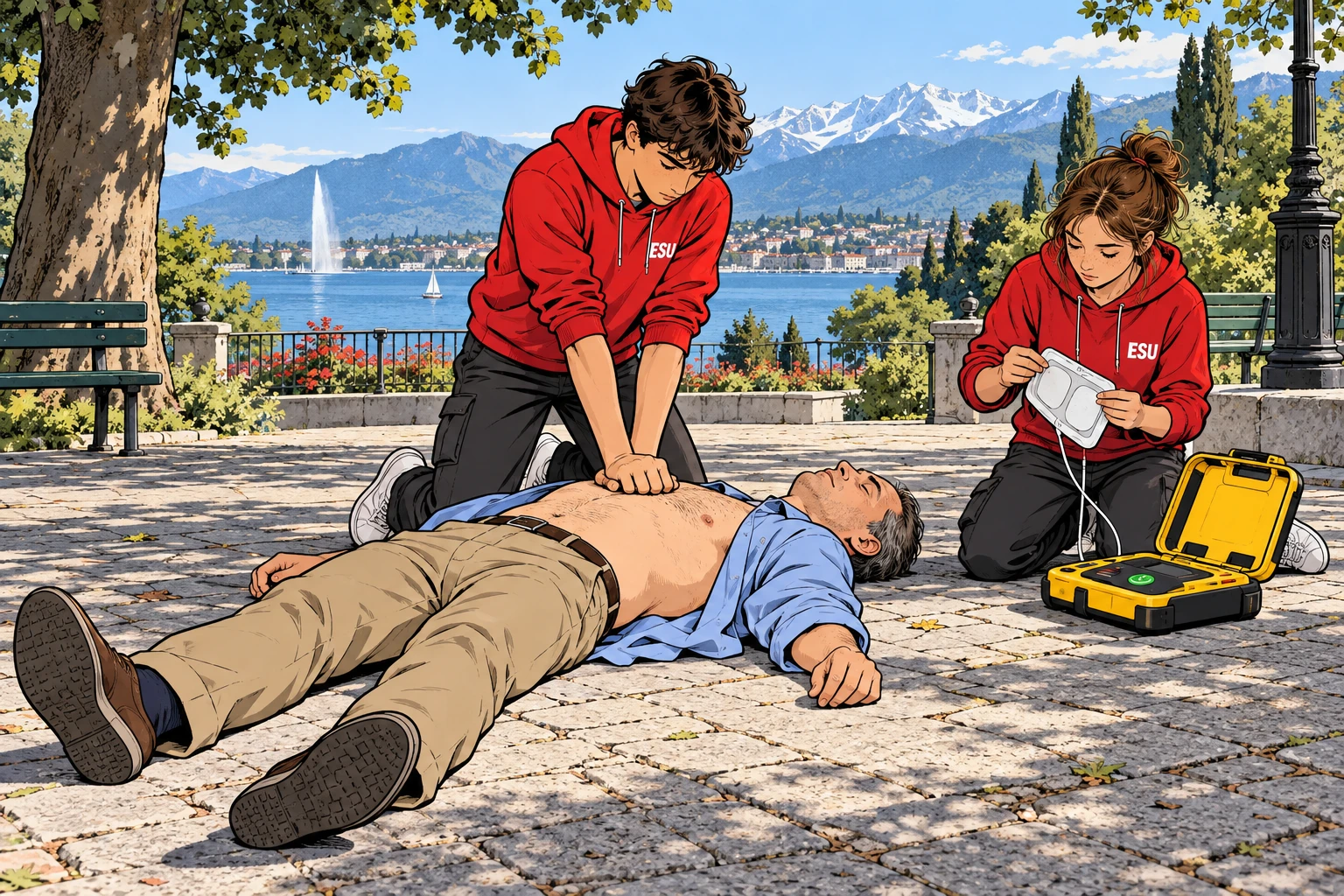
Turn it on and listen.
The person is unresponsive and not breathing normally. The call to 144 and chest compressions have already started: use the AED as soon as it is available.
You do not need to identify the heart rhythm. The AED analyses it and tells you what to do next.
Four steps guided by the AED.
- 1
Turn on
Open the device and follow its instructions to turn it on. Listen to the voice prompts and look at the displayed guidance.
- 2
Attach the electrode pads
Expose the casualty’s chest. Attach the electrode pads to bare skin as shown on their packaging. For an adult, place one below the right collarbone and the other on the left side of the chest, below the armpit.
If there are several rescuers, the other rescuer continues chest compressions while the AED is prepared and the pads are attached.
- 3
Make sure no one is touching the casualty
When the AED starts analysing or announces a shock, say clearly: “Do not touch the person!” Make sure everyone is clear and follow the device’s instructions.
- 4
Resume chest compressions
After a shock, or if no shock is advised, resume compressions as soon as the AED instructs you. Keep interruptions as short as possible and leave the AED in place.
It doesn't mean "stop helping."
Some heart rhythms cannot be treated with a shock. If no shock is advised, chest compressions remain essential. Do not try to force the device to deliver a shock. Follow the AED and emergency dispatcher’s instructions until help takes over, or the person shows signs of waking and is breathing normally.
A voice that guides
The device indicates what to do. Its commands may vary according to the model: follow the indications of the one you have.
Automatic analysis
You don't decide for yourself whether the rhythm requires a shock. AED assesses this need.
Keep providing CPR
Apart from the required breaks, continue resuscitation. If you're more than one, arrange a replacement.
At school, at sports or near your home, spot a defibrillator. Checks its exact location and access conditions: is it accessible when the building is closed? During an emergency, ask a witness to bring it without unnecessarily interrupting the gestures.
The laying marks described here concern adults. The adaptations for children and the use of different devices will be trained during the practical course.
Sources and learning design
At school, at sports or near your home, spot a defibrillator. Checks its exact location and access conditions: is it accessible when the building is closed? During an emergency, ask a witness to bring it without unnecessarily interrupting the gestures.
Original ESU Academy text, quiz, illustration and layout. Benchmarks: SRC — directives 2025, version 1.2, Samaritans Switzerland et International Federation of the Red Cross — recommendations 2025. Installation and use are carried out on training equipment.
La chaîne de survieCapsule BD · ESU Academy
Observe. Understand. Prepare to act.
TRAINING VIDEO
Video disponible dans le parcours connecté.